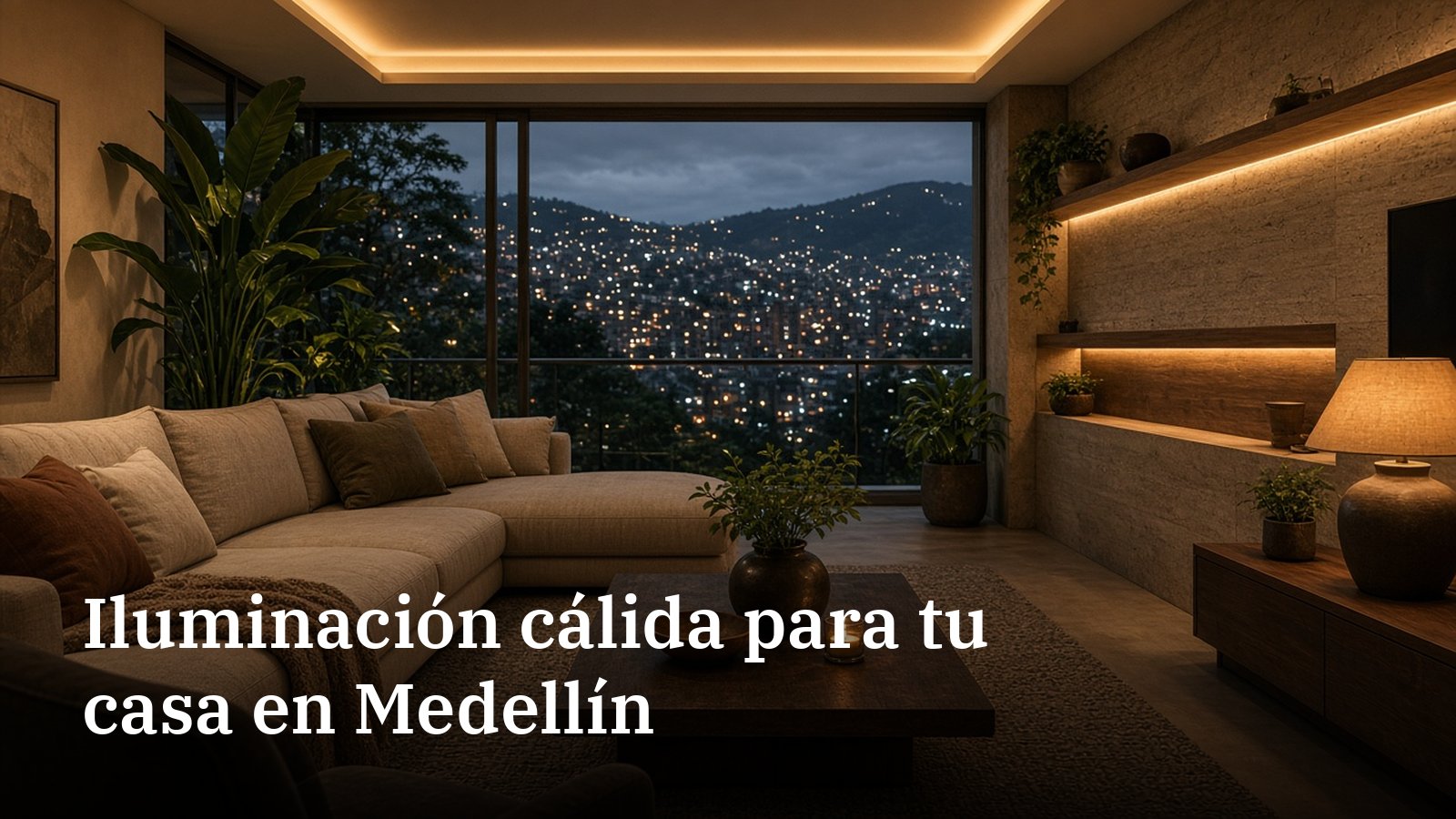
Warm lighting for your home in Medellín
With so much daylight, the home is won in the evening: 2200–2700 K, layers, dimming, circadian scenes, and warm-dim. Criteria I use in Aburrá Valley homes.
I am the founder of Integrated House. In Medellín the sun does most of the work by day. Wide façades, clear skies much of the year, apartments that at eleven in the morning barely need a lamp. The classic mistake is designing the home as if it were a northern European office: 4000 K everywhere, “task light,” white ceilings at full blast. That home feels like a hospital at nine at night.
Here the lighting project is won in the evening and at night. By day you open the blinds; at night you want visual warmth, not a workshop.
If you are choosing strips, power supplies, and profiles, go through the LED lighting technical guide first. If you are ordering priorities for the home, home automation in Medellín and the smart home guide give the frame.
Why I push 2200–2700 K at night
Color temperature in kelvin is not a catalog detail. It is the mood of the room.
- 2200–2400 K: very warm, close to a candle or a very dim old bulb. Ideal for the bedroom at the end of the day, the hallway at 2 a.m., “good night” mode.
- 2700 K: the “home” warm people recognize. Dinner, living room, arriving from work.
- 3000 K and up: starts to feel commercial or like a hotel bathroom. By day, with sun coming in, you notice it less; at night it fights calm.
In living rooms with a lot of west-facing glass, the afternoon already brings a natural gold. Forcing cool light in the cove at that hour is fighting the landscape. I prefer warm layers that ride with the sunset and, if you need more neutral white, keep it in the kitchen or desk zone—not the whole home.
Layers: not one strip “for everything”
A single LED line at 100% is not a lighting project. It is a sign. I work in layers:
- Ambient: cove, luminous baseboard, under-cabinet. Low intensity, almost always warm.
- Task: over the island, the mirror, the desk. There temperature or lumens can go up a bit, but with dimming.
- Accent: a painting, a texture, a hallway. Little flux, a lot of effect.
When someone arrives and hits “all lights,” the home shouts. When they arrive to an ambient scene at 30%, the home receives them. The difference is not the LED budget; it is having thought in layers.
Real dimming, not just “smart on/off”
A relay that turns a strip on and off without dimming solves the phone, not the night. In bedrooms and living rooms I want smooth dimming, preferably at the LED (PWM or a proper controller), not a weird trick that flickers at 10%.
Details we check on site:
- That the controller and strip are compatible at low brightness (a lot of cheap LED “works” only above 40%).
- That nighttime off follows a curve, not a hard cut, especially in hallways with a sensor.
- That the wall switch still works: the app is extra, not a toll.
Scenes with circadian sense (without selling miracles)
I do not promise medical therapy with a Kelvin. I do design schedules that respect how people live here:
- Morning: raise blinds, little artificial light; if needed, soft neutral in the kitchen.
- Afternoon: when the sun hits hard, lower blinds and do not compensate with a full cold ceiling.
- Sunset / arrival: ambient 2700 K, medium intensity.
- Night / good night: drop to 2200–2400 K, turn off task lights, leave only bathroom paths at a very low level.
That ties into the same scenes as the rest of the home: climate, blinds, media. A “movie” scene that leaves the ceiling at 4000 K is not a movie scene.
Warm-dim: the idea that explains itself in one sentence
Warm-dim (or dim-to-warm) is simple: when you lower intensity, the light gets warmer, like an incandescent bulb dimming. It is not required on every meter of strip, but on table lamps, pendants, and some living-room circuits it changes the feel from “plastic LED” to “home light.”
If you use a CCT strip, you can simulate part of the effect in software: at lower brightness, more weight on the WW channel. It is not identical to an LED designed for warm-dim, but for coves it works very well and avoids buying five different product families.
What I avoid in Aburrá Valley apartments
- Uniform 4000 K ceilings “because they light more.” They light more and tire more.
- A single scene for the whole day.
- Negotiating only lumens per meter and forgetting the diffuser and profile (ugly light looks just as ugly in warm).
- Brand apps that will not tie light to blinds and AC. Light alone is incomplete; the context is in home automation in Medellín.
From warm to effect (when you actually need it)
Sometimes the living room wants a slow sunset in the cove, a hallway that lights as you walk, or a cinema mode that is not just “turn everything off.” That is zone or addressable control, open and local. I cover it in LED effects, WLED, and Matter. The electrical and product base is still the LED technical guide.
At Integrated House we design and install this lighting: temperature, layers, dimming, and scenes that match how Medellín is actually lived. If you want to review your home, write to us from the site.